- Lessons in an app that barely covers Shona
- Word games, none of them in Shona
- Conversation practice with an expensive tutor, on a schedule
- Vocabulary in flashcards, in yet another app
- Pronunciation from YouTube, and hoping for the best
- Culture and proverbs scattered across blogs and family WhatsApp

Find your way back to Shona.
Lessons, conversation, word games, vocab, culture. The whole language in one quiet app, for Zimbabweans in the diaspora and anyone reaching back for Shona.
Stop juggling apps.
Until now, learning Shona has meant a different tool for every piece, and giving up on most of them. Afri-Speak gathers the whole language in one quiet place.
All of it. One app.
Lessons, conversation, two daily word games, vocab in context, pronunciation, and the cultural moments the language lives inside. Built around Shona as people actually speak it today, not the textbook version.
Some pieces ship at launch, others land soon after. The waitlist gets you the launch note and a quiet hello before then.
No beginners. No experts. Just people coming home.
You moved. The language stayed.
Wherever you ended up, daily Shona practice isn't just around you. Afri-Speak meets you in the slivers of time you actually have.
You can follow the conversation. You just can't quite join in.
No classroom, no grades, no spotlight. A private space to practise until the words feel like yours.
Reaching back to a language that's part of you.
Spouses, partners, grandchildren, friends. Anyone stepping into Shona is welcome here.
Every way back.
Conversation, lessons, games, vocab, pronunciation, culture. Built around how Zimbabweans actually speak today.
An AI tutor that listens
Soon, real Shona conversations at your pace and in your accent, with patient correction that feels like a friend rather than a teacher.
Five minutes, every day
Tiny lessons that fit into your morning coffee or your commute. Streaks without the guilt.
Mazwi & Nyuchi
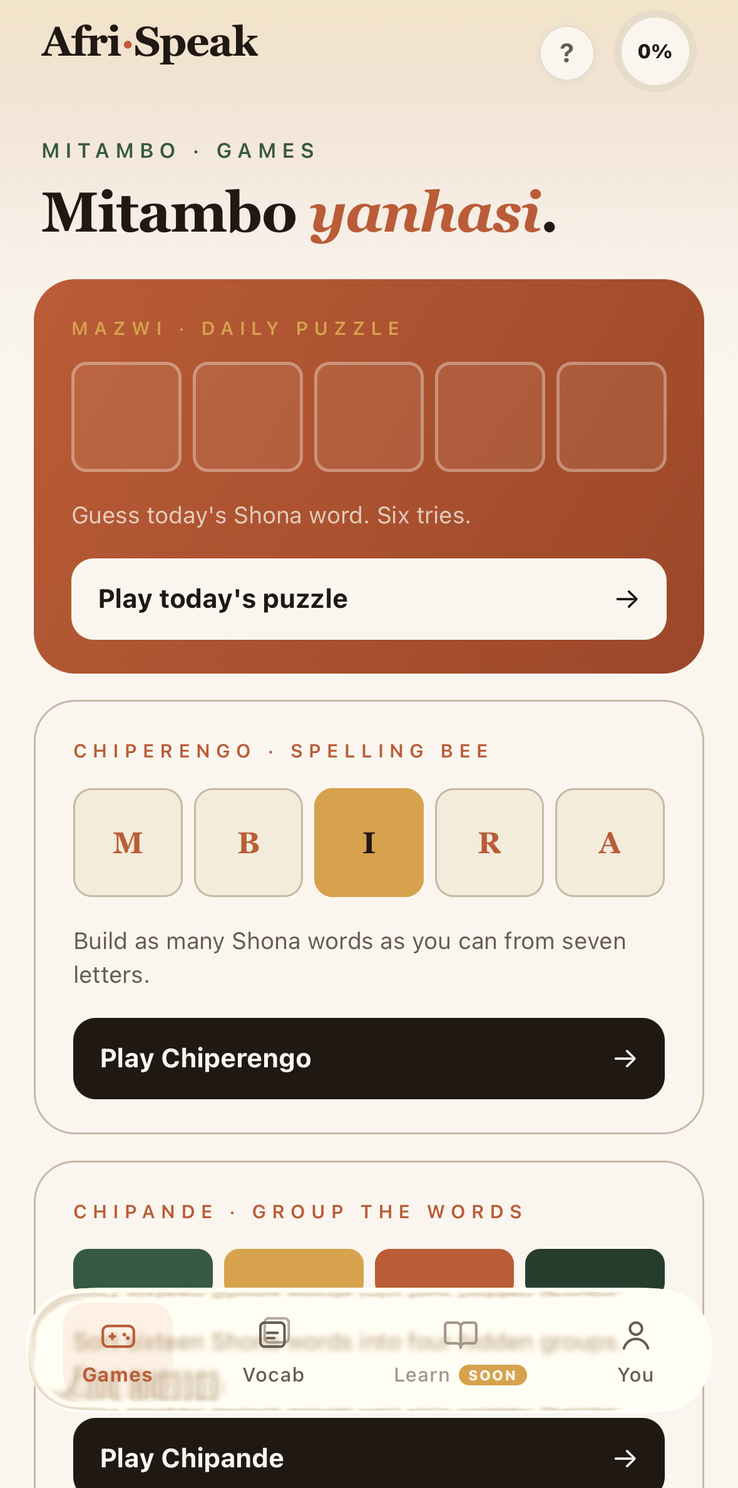
Two daily Shona word puzzles, built on a real Shona dictionary. Mazwi for guessers (Wordle-inspired). Nyuchi for builders (spelling-bee-style). Vocabulary by stealth.
Words with context
Every word comes with a story. The proverb it lives in. The village it's from. The way your gogo would say it.
Speak with confidence
Pronunciation feedback so when you call home, you sound like you mean it.
Cultural moments
Music, history, mbira, mufushwa. The language doesn't live in a textbook, and neither do we.
The questions everyone asks.
Is Afri-Speak like Duolingo for Shona?
In some ways, yes, and it goes further. Afri-Speak pairs daily five-minute lessons with an AI tutor you can actually have a conversation with, plus Shona word puzzles (Mazwi, Wordle-inspired; and Nyuchi, spelling-bee-style) and vocabulary built around the language as Zimbabweans speak it today, not the textbook version.
Will it work if I already understand Shona but can't speak it?
Yes. That's the most common starting point we design for. The tutor lets you reply in English while it answers in Shona, then gradually flips the ratio as you find your voice. No pressure to perform on day one.
Is the AI tutor in Shona, English, or both?
Both, by default. You can talk to it in English and it'll respond in Shona with translations, or set it to Shona-only once you're comfortable. Pronunciation feedback works on whatever you record.
How is this different from a textbook or YouTube?
Textbooks teach you formal grammar that nobody actually uses when you call home. YouTube channels are great but passive. Afri-Speak is conversational, patient, and adaptive. It listens, corrects gently, and remembers what you've practised so it can build on it.
What does Afri-Speak cost?
We haven't finalised pricing. The plan is a free tier with daily lessons, Mazwi and Nyuchi, plus a paid tier (likely under five US dollars a month) for unlimited tutor conversations and pronunciation feedback. Everyone on the waitlist gets early access pricing.
When does it launch?
Soon. We're building it in 2026 and aiming for a public iOS launch later in the year. Joining the waitlist gets you the launch announcement and a personal hello before that.
Will there be Android or web versions?
We're starting on iOS, with Android and a web version close behind. Wherever you are, however you connect, Afri-Speak will meet you.
Can my kids use it?
It's designed for teens and adults reclaiming the language, but the content is family-safe and works fine for confident readers. We're planning a kids-specific track later, with Shona stories and games rather than chat.
Three steps. No pressure.
- 01
Tell us where you are
A short, no-judgment check-in. Maybe you understand a little but never speak. Maybe you're starting from zero. Both are fine.
- 02
We shape a path that fits your week
Five minutes a day. Fifteen if you have it. Skip a day. Your streak doesn't shame you for living a life.
- 03
You speak. Then you keep speaking.
Real conversations from week one. Quiet wins that compound. The next time you call home, something shifts.
“Kuziva mbuya huudzwa.”
To know your grandmother, you have to be told. Heritage doesn't pass without telling. Your language has been waiting for someone to walk it back to you.

Note from the founder
“I built Afri-Speak because nothing else met me where I was.”
I grew up in Harare understanding more Shona than I could speak. School pulled me in one direction, family in another, and somewhere between the two the language quietly became something I recognised but didn't use. Eventually I'd stopped trying.
Afri-Speak is the app I wish had existed back then. Patient, private, and built by someone who knows what it's like to almost speak the language of your own family. If that's you too, I'm so glad you're here.
— Tanyaradzwa Gozhora, founder
The first 1,000 spots come with early access and a thank-you from us.
Drop your email. We'll send one note when Afri-Speak goes live on the App Store, plus a personal hello before launch.